Gorpcore · straight through the leg from a full hip, sits at the natural waist
Duck Canvas Carpenter Pant
SwitchbackHammer
340 GSM garment-washed cotton duck, 42 cm waist, 54 cm hip, 24 cm leg opening, 76 cm inseam, zip fly, hammer loop, ruler pocket, welted back pocket
FRONT
BACK
Free vector flat
No account
The drawing above, front and back, as an editable vector — open it in Illustrator, Figma or Affinity and put your own graphics on it. Measurements aren't on the flat; they're in the tech pack.
The vector flat above is free and always will be. The tech pack — graded measurements, tolerances, fabric weights and construction — is the paid part.
Starting spec — make a sample before you order in bulk.
New to tech packs? Read how to make one, step by step →Fabric
340
GSM · Extra heavyweight · range 300–400
Cotton duck canvas (10 oz) — 100% cotton. Piece-dyed then garment-washed with softener; one wash, no enzyme stone. Raw duck is board-stiff and the first drop will be returned
Trim: Pocketing twill · 80% polyester / 20% cotton · 110 GSM
What does GSM mean? Read the fabric weight guide →How it's made
Waistband
Straight fused waistband, 4 cm finished, no elastic · closure: Zip fly with a two-ply shield; one 17 L shank button at the band · belt loops: 7
Fly
Zip fly, 15 cm #4.5 brass coil · topstitch: J-stitch 0.6 cm, bar-tacked at the bottom of the fly
Pockets
front: Slant side pockets, 16 cm opening, bagged in pocketing twill, bar-tacked both ends · hammer loop: Wearer's left side seam, 2.8 cm wide x 11 cm, self fabric double-folded, bar-tacked top and bottom through the side seam · ruler pocket: Wearer's right thigh, 7 cm x 17 cm patch divided into a 4 cm and a 3 cm channel, top edge turned 2 cm and bar-tacked · back: One welted pocket, 14 cm, wearer's right
Body hem
2 cm 2 cm turned-up hem, single-needle, chainstitched
Seams
Side seams and inseams flat-felled 0.8 cm; seat seam flat-felled and bar-tacked at the crotch junction
Stitch density spi
9 stitches per inch
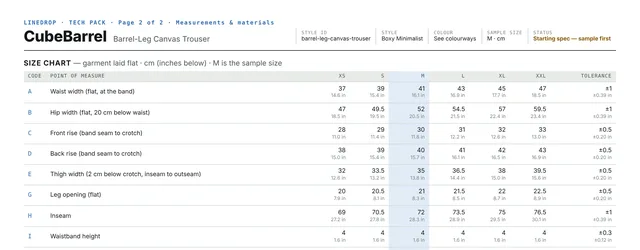
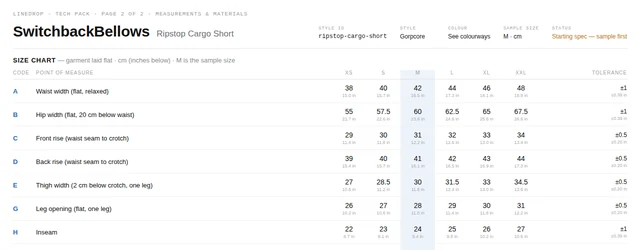
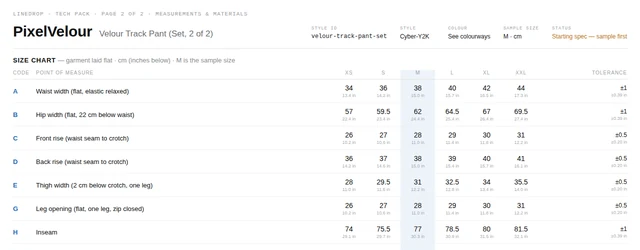
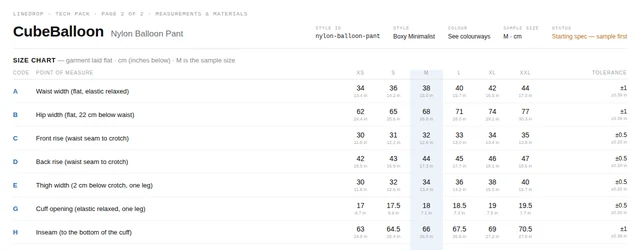
Size chart
Garment laid flat · M is the sample size
Measure
XS
S
M
L
XL
XXL
A
Waist width (flat, at the band)
± 1 cm
38
40
42
44
46
48
B
Hip width (flat, 20 cm below waist)
± 1 cm
49
51.5
54
56.5
59
61.5
C
Front rise (band seam to crotch)
± 0.5 cm
28
29
30
31
32
33
D
Back rise (band seam to crotch)
± 0.5 cm
39
40
41
42
43
44
E
Thigh width (2 cm below crotch, inseam to outseam)
± 0.5 cm
30
31.5
33
34.5
36
37.5
G
Leg opening (flat)
± 0.5 cm
23
23.5
24
24.5
25
25.5
H
Inseam
± 1 cm
73
74.5
76
77.5
79
80.5
I
Waistband height
± 0.3 cm
4
4
4
4
4
4
Colourways
Washed Tan
#C2A878
Faded Olive
#6E7254
Washed Black
#32322F
Trims & notes
• #4.5 brass coil zip, 15 cm (fly)
• 17 L shank button (waistband) + 1 spare
• Fusible waistband interlining
• Pocketing twill (~0.4 m per garment)
• Bar-tack thread, tex 60
• Woven label (inside back waistband)
• Care label (left pocket bag)
• Garment-wash once with softener and stop there. The brief is a workwear pant that is wearable on day one, not a distressed one — the research is explicit that heavy distressing is being phased out, and every extra wash cycle is cost for a finish the market is leaving.
• 10 oz duck is the ceiling for a first run. Above 12 oz the flat-felled seams need a heavier machine and a different needle, and the quote changes line.
• The hammer loop is the garment. It is also the first thing a factory drops as a simplification, so it has a POM-level callout on the flat and a bar-tack spec: through the side seam, both ends, or it tears out with the first load.
• Give the ruler pocket its divider. A single undivided patch is a phone pocket, and the proportions read wrong against the hammer loop.
• A 24 cm leg opening against a 54 cm hip is the straight-leg silhouette. The research says ultra-baggy is losing its default status and skinny has no consumer evidence behind it — do not let a factory 'balance' this to either end.
• Duck canvas is directional after washing. Mark the grain line on every panel and cut all legs the same way, or two legs fade differently.
© 2026 LineDrop · Starting specs — always make a sample first.